I have been thinking about (some may say procrastinating!) setting up my own personal website for ages.
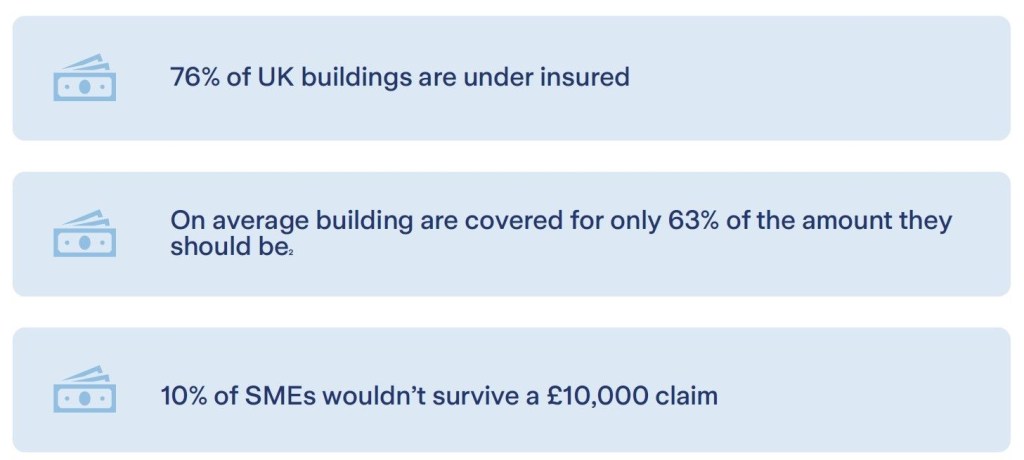
It was the slide above which at last kicked me into action!
I will write on more exciting subjects going forward! However this is such a hot topic and I’d like to air it in the most simple of terms.
This slide I saw for the first time on 8th November, courtesy of Zurich Insurance. In my own personal experience over recent years, I have no reason to question any of those figures.
Using the 63% figure above, here is how this looks for a total loss Buildings claim (and the same principle applies to sums insured for other assets, not just your premises):
Buildings sum insured of £250K | Insurer pays £157.5K | Owner pays £92.5K
Buildings sum insured of £1M | Insurer pays £630K | Owner pays £370K
£1M is a modest Building value, almost certainly owned by an SME business. Very few if any SME’s can absorb a £370K P&L hit 😯
Most readers will know what a “policy excess” is – essentially the self-insured portion of a claim, your contribution.
Using the £1M example above, a bog standard fire excess could be in the region of £500. Imagine the shock of finding out after a significant fire that your contribution will be £370,500!
It doesn’t bear thinking about…and is so easily rectified. A lot of cautious businesses are unwittingly gambling and with very high stakes 🤔 Whatever it takes to establish the correct sum insured should be done, for both financial prudence and peace of mind.
If applying the same principle to a Company Car, under what circumstances would you be willing to accept an excess equivalent of upwards of £11K on a £30K vehicle or more than £18K on a £50K vehicle? I suspect this would never be acceptable, it presents an unnecessary financial burden on a business.
Underinsurance is a major issue and should be very high on the agenda of your Insurance Broker. If you’re not being challenged on values, this is a potential red flag.


Leave a Reply